


Can You Get a Traffic Ticket Dismissed in New York?
Take the sting out of that ticket.
A DMV-approved PIRP course takes up to 4 points off your suspension total and trims your premiums by 10 percent for three years. All online, at your own pace.
Quick Answer:
- A New York ticket is dismissed only through the court: a not guilty finding, a case the judge throws out, or, outside New York City, a prosecutor who agrees to drop or reduce it.
- Tickets from the five boroughs go to the DMV's Traffic Violations Bureau, which doesn't allow plea bargaining; everywhere else, the local court printed on your ticket handles it.
- A DMV-approved PIRP course can't erase the ticket, but it subtracts up to 4 points from your suspension total and cuts your liability and collision premiums by 10 percent for three years.
A ticket in New York starts a clock, and the choices you make in the next few weeks decide what it costs you. Here's where your ticket goes, what your plea options really are, how points add up under the current rules, and the one course that softens the blow no matter how your case ends.
Can a New York Ticket Actually Be Dismissed?
Yes, but only through the court. A New York traffic ticket is dismissed when you're found not guilty, when the judge throws the case out, or when a prosecutor outside New York City agrees to drop it. No course in New York dismisses a ticket on its own.
When Dismissal Is Possible
- The evidence at your hearing doesn't prove the violation.
- The ticket has an error the court treats as serious, such as a wrong date or missing location.
- Speed evidence is challenged, for example over how a radar or laser device was calibrated.
- Outside New York City, a prosecutor agrees to drop the charge, often for drivers with a clean record.
If you plan to contest, our guide on how to fight a ticket walks through building your case.
What a Course Can and Can't Do
Some states let a defensive driving course wipe out a ticket. New York isn't one of them. What New York offers instead is the Point and Insurance Reduction Program (PIRP), which protects your license and your premiums after the fact. More on that below.
Where Does Your Ticket Go: NYC or a Local Court?
Where you got the ticket decides who handles it. Non criminal moving violations from the five boroughs go to the DMV's Traffic Violations Bureau (TVB). Tickets from the rest of the state go to the city, town, or village court listed on the ticket.
Inside the Five Boroughs: The Traffic Violations Bureau
At the TVB, you plead guilty or not guilty. There's no deal making, so a not guilty plea leads to a hearing where the outcome is either guilty or not guilty. You can enter your plea for a TVB ticket online through the New York DMV.
Everywhere Else: Your Local Court
Outside New York City, follow the instructions on your ticket and contact the court directly. Many local courts let the prosecutor offer a reduced charge, such as a lower speed or a violation that carries fewer points, especially if this is your first traffic ticket.
Infraction or Misdemeanor?
Check how your ticket is classified. Most moving violations are traffic infractions you can answer by mail or online. A misdemeanor is a criminal charge and usually means appearing in court, so treat it as a different situation and consider talking with an attorney.
What Are Your Plea Options?
Every New York ticket needs an answer by the deadline on the ticket, and your plea sets the path.
Plead Guilty
You pay the fine and surcharge, and the points go on your record. At the TVB, a guilty plea can't be changed later, so make sure that's the outcome you want.
Plead Not Guilty
You get a hearing, or a trial in a local court, where the officer's evidence is tested. A not guilty finding means no fine and no points.
Ask About a Reduced Charge
Outside New York City, you can ask the prosecutor to reduce the charge to a lesser offense. A reduction can lower the points or keep the conviction from counting as a speeding violation. This option isn't available at the TVB.
Don't Miss the Deadline
If you don't answer on time, the DMV suspends your license for failure to answer, and it stays suspended until you respond. Driving during that time creates a bigger problem than the ticket ever was; see what happens when you're caught driving while suspended.
How Do Points Add Up After a New York Ticket?
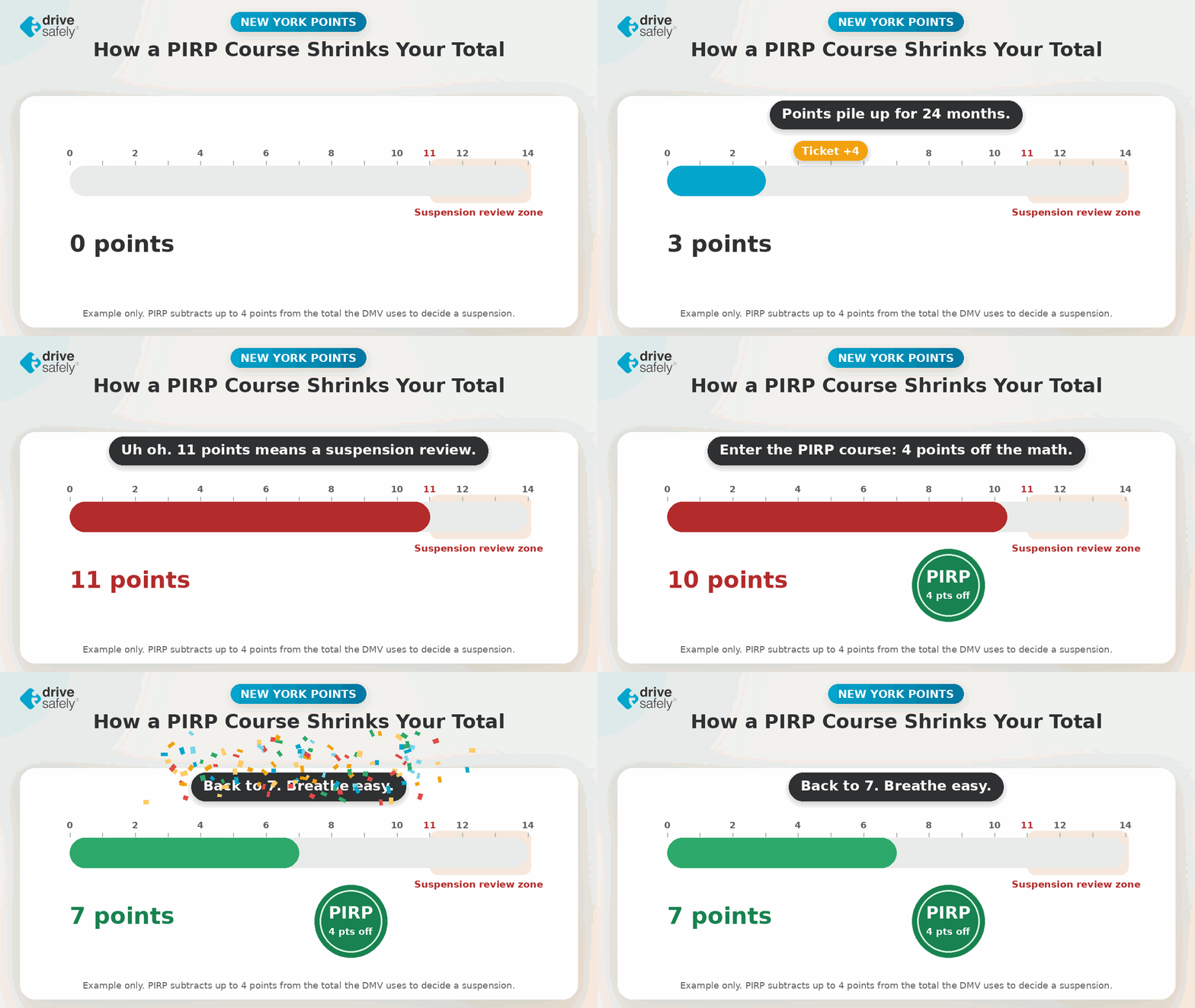
New York counts points from violations within the last 24 months, and 11 points in that window can lead to a license suspension.
Common Point Values
Speeding 1 to 10 mph over the limit carries 3 points, and higher speeds and more serious violations carry more. Several violations now carry higher values than they used to, so look up the current number for your ticket rather than relying on an old chart. Our guide to New York points lays out how the system works today.
The 24 Month Window
Points stop counting toward your total 24 months after the violation date. The conviction itself stays on your record longer, and your insurer can still use it to raise your rate, which is a big part of how points affect insurance.
The Driver Responsibility Assessment
Reach 6 or more points within 18 months and the DMV bills you a Driver Responsibility Assessment, an annual fee charged on top of your fines. Not sure where you stand? Here's how to check your points.
How Does a PIRP Course Help?
A PIRP course is the New York version of defensive driving: it doesn't dismiss your ticket, but it gives you a 4 point buffer against suspension and a 10 percent insurance reduction. I Drive Safely's New York PIRP course is DMV approved, fully online, and built around short, engaging lessons you can finish at your own pace.
Up to 4 Points Off Your Suspension Total
When the DMV calculates whether to suspend your license, it subtracts up to 4 points from your total. The violations stay on your record, but the buffer can keep you below the suspension line.
10 Percent Off for Three Years
Completing the course reduces the base rate of your auto liability and collision insurance by 10 percent for three years. To keep the reduction going, take the course again every 36 months.
Rules Worth Knowing
- You can use a course to reduce points once in an 18-month period.
- The reduction applies to points from violations in the 18 months before you finish the course.
- It doesn't cancel a mandatory suspension or revocation for DWI, DWAI, or three speeding violations within 18 months.
- It doesn't lower a Driver Responsibility Assessment.
- Your course provider notifies the DMV, which can take up to 10 weeks.
Get every official detail on the DMV's PIRP page.
New York Ticket Questions, Answered
Quick answers for drivers holding a ticket right now.
Will a defensive driving course take the ticket off my record?
No. In New York, a PIRP course reduces the points used to calculate a suspension and lowers your insurance rate, but the conviction stays on your driving record.
Can I plead not guilty online?
For tickets handled by the TVB in New York City, usually yes, through the DMV's online plea service. For tickets anywhere else, contact the court listed on your ticket.
Should I take the PIRP course before or after my case ends?
The insurance reduction applies whenever you finish. For points, the reduction covers violations in the 18 months before you complete the course, so finishing after a conviction is posted still helps.

How to Get a Traffic Ticket Dismissed in Virginia
Your options after a Virginia traffic ticket, and when a state-approved driver improvement course can reduce points or help your case in court.

The Top 7 Parts of Your Car You'll Need to Replace
Your car will eventually need to have many parts replaced. Sticking to the suggested maintenance schedule will keep your motor humming and your passengers safe.

A Step-by-Step Guide to Dismissing Your New York Traffic Ticket
What to do after a New York traffic ticket: pleading, traffic court, how points work, and how the online PIRP course can reduce points and lower your insurance.
Looking for more driving resources?
Enter your email for deals, study materials, car maintenance tips, insurance savings, and more.